
Digitizing Old Line Industries: Commodities


At SNAK Venture Partners we lead seed stage deals in category-defining digital marketplaces. Because marketplaces tend to be winner takes all or winner takes most, there is an advantage to being the first to bring a marketplace online. Getting to scale first and locking up supply and demand through network effects makes it harder for competitors to copy your model. This is why marketplaces tend to create the most valuable companies, and since 2010 50% of top 10 IPO outcomes for VCs have been marketplace model businesses.
As a result, we’re always thinking about where there is whitespace to be the first to bring a market online and build a category-defining marketplace. One of the places where we’ve recently done a deep dive, and believe there is a lot of whitespace, are commodity based B2B marketplaces. Commodities must be produced, transported, and distributed to consumers and enterprises. Expensive infrastructure is required along the entire chain of production through distribution. While the trading floors and exchanges have long been digitized, in the value chain, the distribution layer is the piece most likely to be disrupted by digital exchanges. These are the transactions that occur to facilitate the distribution of products for producers and end consumers, and these transactions are still largely offline.
Commodities can be classified in 4 main categories:
Energy
Metals
Agriculture
Livestock
Energy
This industry consists broadly of fossil fuels and alternative energy. Fossil fuels include oil, natural gas, coal, and uranium. The alternative energy industry includes solar, wind, water, biomass, geothermal and fuel cells. Electricity is a secondary source of energy, generally powered by fossil fuels.
This was the underpinning of our investment in FuelMe at Pritzker Group, an online marketplace for fuel distribution. Crude oil is the most highly traded, largest, and most valuable marketplace in the world. Historically, B2B bulk purchasers of fuel have relied on regional distributors and antiquated systems to procure fuel. For buyers, aggregating the fragmented supply creates the ability to more easily compare options and access options outside a region, and the ability to get better pricing for enterprise bulk fuel buyers. For sellers, the online marketplace offers the ability to increase sellers’ reach. For both sides, technology improves transparency, efficiency through automation, and creates datasets that previously did not exist. FuelMe is the first mover in the category taking an asset-light, marketplace approach.
While FuelMe has the early lead in fossil fuels, we expect there to be more opportunities in the alternative energy space. Alternative energy sources are poised to grow at a faster pace in the coming years based on consumer and climate interest, and the existing infrastructure is less mature, leaving many subcategories with whitespace for startups to fill.
Metals
The metals sector includes both precious and industrial metals. Metals can be further divided into noble metals (e.g., gold, platinum, silver), base metals (e.g., copper, lead, tin), and light metals (e.g., aluminum, titanium). Iron is in a category of its own because it is the most widely produced and traded metal and is used primarily in the form of steel.
Metals are a non-renewable, or exhaustible, resource; hence supply is limited by rate of extraction. Geologic conditions, technology, economic conditions, resource ownership and concentration, and metallurgy are major areas that determine the supply of metals. Demand for metals arises from fabricators, various industrial sectors, durable goods and packaging consumption.
Within each metal market and submarket we once again are most interested in startups disrupting the distribution layer. Also, because metals are recyclable, scrap has become an important secondary source of some metals and likely to become more important in the future and is a place where we’d like to place some bets.
Agriculture & (4) Livestock
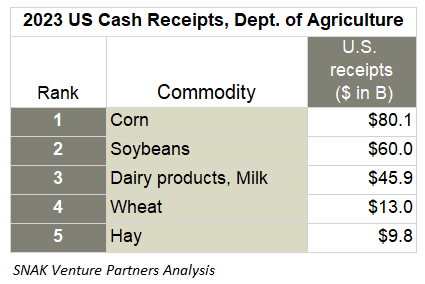
Within agriculture, in the U.S. the top 5 categories are:
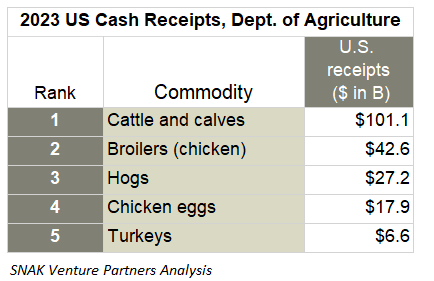
Within livestock, in the U.S. the top 5 categories are:
We’ll share more about the whitespace we see in these subcategories in the future. If you’re building a digital marketplace in any of these areas, we’d love to connect.
Email us at contact@snak.vc, we’d love to chat.